Terpene groups to characterize varieties

23 June, 2023
Alexis St-Gelais, Ph. D., chimiste

The intensive selection process applied to cannabis produces strains with diverse molecular signatures, and this is particularly apparent when examining terpene profiles. These specificities can be useful for characterizing a strain or extract, highlighting what makes it unique compared to other varieties. Based on our extensive experience with cannabis terpenes, let's explore some interesting molecular trends in this plant.

Chemotypes and cannabis

The production of molecules in a plant follows a metabolic logic. A rough parallel can be drawn with human eye color: depending on an individual's genetic characteristics, our body may or may not have the capacity to generate pigments that, in turn, determine the hue of the iris. This hue (although with many nuances) can be classified into a limited number of categories, such as blue eyes. To study plants, the concept of chemotype can be used to describe this phenomenon where molecules are present in some individuals and not (or only in small quantities) in others. Polatoglu suggested the following definition for this concept: organisms categorized as belonging to the same species […] and exhibiting differences in the quantity and quality of their component(s) in their total chemical signature, these differences being linked to genetics or to differences in gene expression [1].

In cannabis, cannabinoid expression tends to follow chemotypic patterns, where one or two dominant cannabinoids are observed and can vary from one strain to another. In The Handbook of Cannabis, de Meijer proposes a model comprising three genetic factors and one morphological factor that can lead a given variety to express one of nine possible chemotypes (or even more, since mixed chemotypes can be observed where two molecules are codominant, most typically THCA and CBDA) [2]. This model is summarized in Figure 1 below, where the term "locus" refers to a region of a chromosome in the cannabis plant where the genes present will influence the metabolic expression of cannabinoids.

Figure 1. A genetic model proposed by de Meijer [2] (figure adapted by PhytoChemia) explains cannabinoid chemotypes. A first locus controls the expression of enzymes necessary for the synthesis of metabolic precursors of the phenolic portion of cannabinoids – if this locus is inactive, the plant will not have access to the required metabolic raw materials and no cannabinoid will be produced. A second locus controls the length of the carbon chain attached to this phenolic skeleton, defining a proportion between C3 and C5 phenolic acids (respectively divarinolic and olivetolic acids, the latter constituting the precursor of common THCA and CBDA). A third locus functions according to a pattern similar to that of human blood groups A/B/AB/O (this parallel is ours, not de Meijer's). If the locus is inactive (like blood type O), metabolism stops at CBGA (or CBGVA); When type A genetic information is present, THCA is produced, while type B allows the synthesis of CBDA (and both types can be present, as with blood type AB, producing a mixed chemotype). A fourth parameter can come into play and relates to the morphology of the trichromes, which in some cases can lead to the conversion of CBGA to CBCA and produce a wider range of chemotypes.

As far as we know, such an integrated model for cannabis terpenes remains to be defined (let us know if you know of one!). However, you can see from the example of cannabinoids that the genetic traits of a strain can determine whether or not a molecule will accumulate as a result of a plant's metabolism – or, in other words, whether a strain will belong to a given chemotype.

Correlated terpenes

Often, a given metabolic transformation is carried out by an enzyme, that is, a protein capable of facilitating a particular chemical transformation. Enzymes can be more or less selective regarding the molecules they can transform. When several molecules have a similar structure, they can sometimes all be transformed by the same enzyme, although not necessarily all at the same rate or with the same efficiency. This implies that if a plant expresses a particular enzyme due to its genetic traits, sometimes not just one but several molecules may result. In other cases, if an enzyme allows the transformation of a key molecule upstream, several downstream transformations can become possible since the "raw material" becomes available. In all cases, even without knowing the details of the metabolic and genetic mechanisms involved, we can observe whether there are correlations between molecules, which would imply that they have a common origin. If this is the case, we should consider these compounds together, since it is unlikely that one would be observed and not the others.

There are several examples of such groups among the terpenes in cannabis. Here are some quantitatively significant groups to keep an eye on:

  • Pinenes are correlated with each other, with varying proportions of α- and β- isomers;
  • When limonene is abundant, a series of oxygenated monoterpenes also tend to have a higher content;
  • A high proportion of terpinolene will be accompanied by the presence of several other monoterpenes;
  • β-caryophyllene and α-humulene are strongly correlated;
  • A group of eudesmane (or selinane) type sesquiterpenes are closely related. It includes α- and β-selinenes, some selinadiene isomers and juniper camphor. They also correlate with spirovetiva-1(10),7(11)-diene and eremophila-1(10),7(11)-diene;
  • α- and δ-guaienes are observed together;
  • Germacrene B is always associated with γ-elemene in GC analyses, since the latter is a thermal degradation product of germacrene B and is thus systematically generated during the analysis. (E)-α-bisabolene and α-bisabolol tend to partially correlate with germacrene B;
  • Finally, a cluster of sesquiterpenols including guaiol, eudesmols, bulnesol and cryptomeridiol are clearly linked to each other in terms of abundance.

Behavior of terpene groups from one variety to another

Through our analyses of thousands of samples, certain trends have become apparent within the groups described above. Here are some of the phenomena we have observed in our analyses. Keep in mind that with intensive selection, a producer can always come across something unusual: the elements below are trends, not absolute rules!

Monoterpenes

The terpene profile is most often dominated by one or more of the following monoterpenes: myrcene, α-pinene*, limonene*, terpinolene*, (E)-β-ocimene, and linalool—the latter two very rarely being the dominant compound. Remember that molecules marked with an asterisk are accompanied within their group. From the perspective of metabolic trends, the cases of terpinolene and limonene are particularly interesting.

Regarding terpinolene, its presence appears to be a key metabolic factor in the expression of many other molecules. Since terpinolene is a dominant terpene, a diverse group of terpenes, usually found only in trace amounts, become more visible. Some of these are shown in Figure 2.

Figure 2. Compounds associated with terpinolene in cannabis. These molecules tend to be more abundant in terpinolene-rich strains and are otherwise found in trace amounts or are completely absent. In addition to these molecules, an unknown oxygenated monoterpene is also closely associated with terpinolene. It is eluted near terpinen-4-ol on a DB-5 column.

As for limonene, its concentration is correlated with that of camphene and several oxygenated monoterpenes, including α-terpineol, endo-fenchol, and borneol, as well as pinene hydrates (Figure 3). The latter are uncommon in the field of essential oils, cannabis being one of the few botanical sources where they are present in some abundance alongside the unusual African wild sage (or leleshwa) Tarchonanthus camphoratus.

Figure 3. Structures of molecules correlated with the abundance of limonene in cannabis.

Sesquiterpenes

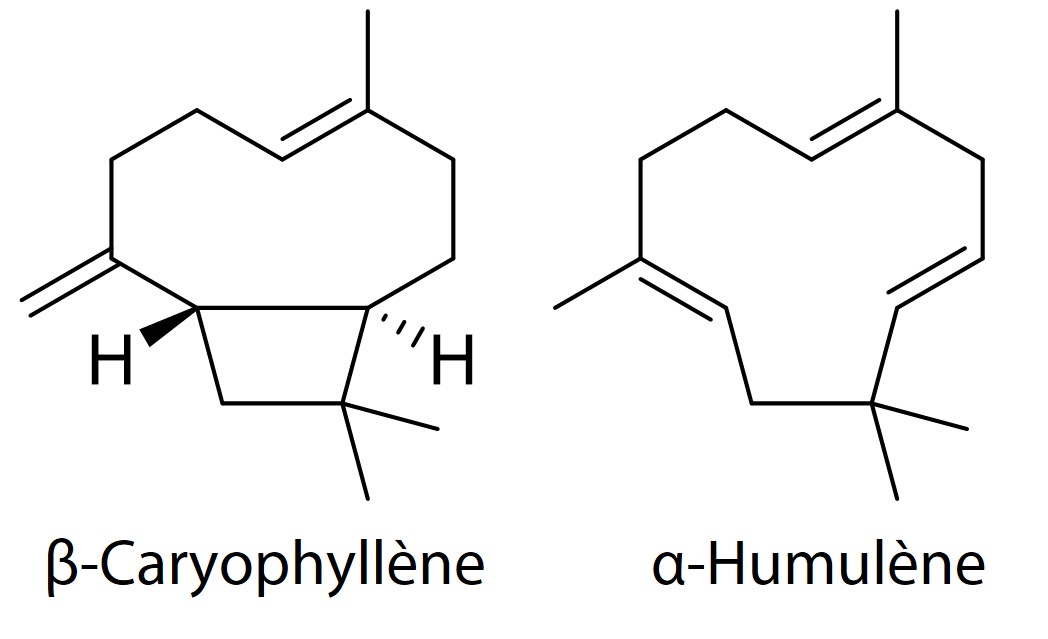
β-Caryophyllene and α-Humulene

These two sesquiterpenes (Figure 4) can sometimes outnumber monoterpenes in concentration within a strain. They are always expressed, unless a strain or extract is almost entirely devoid of terpenes. This is not surprising, since these terpenes are among the most widely distributed in nature—in fact, very few plants producing essential oils do not express them. It is particularly rare to encounter cannabis where the sum of caryophyllene and humulene does not represent at least 1% (relatively) of the total terpenes, and they can be found almost anywhere along their possible concentration gradient. Thus, they do not truly belong to a chemotype, but rather to a continuum.

Figure 4. Structures of β-caryophyllene and α-humulene

Germacrene B

As mentioned above, germacrene B is not thermally stable (Figure 5). When observed on a GC analysis profile, it will inevitably be accompanied by γ-elemene, produced by the partial degradation of germacrene B within the heated injection port of the instrument [3]. These terpenes are not usually among the targets screened by most laboratories, since the germacrene B standard is difficult to obtain – but it can nevertheless be a quantitatively significant component among the terpenes for some varieties. We have seen the sum of germacrene B and γ-elemene significantly exceed 10 mg/g in some cases! There are also varieties where germacrene B is barely present, as well as almost all the possibilities between these two extremes.

There is a certain degree of correlation between germacrene B and a pair of closely related compounds, (E)-α-bisabolene and α-bisabolol, although in some cases we observe examples where they are uncoupled. The α-bisabolene/α-bisabolol duo exhibits chemotypic behavior, being expressed in most varieties, but occasionally inhibited to very low levels.

Figure 5. Structures of germacrene B and compounds strongly or partially correlated with it.

Guaiènes

α-Guaiene and δ-guaiene (Figure 6) are typically found in rose and patchouli essential oils, among others. In many cannabis varieties, these sesquiterpenes are only weakly expressed, but in some cases, their expression is triggered until they represent a few percentage points of the total terpenes. Frankly, it is difficult to track α-guaiene, since it tends to co-elute with another quantitatively abundant cannabis sesquiterpene, trans-α-bergamotene, on several GC columns (including DB-5 and DB-Wax phases). Therefore, δ-guaiene is the compound to monitor to observe this chemotype. There are exceptions, but guaienes are typically found either below 0.5 mg/g or in a range of 1 to 3 mg/g, suggesting that a genetic trait either enables or inhibits their production. α-Guaiene can oxidize over time to generate a strongly odorous compound, rotundone [4] – the latter is probably too low in abundance to be directly tracked in cannabis, but could contribute to the aroma of some strains.

Figure 6. Structures of the guaiènes.

Eudesmanes (Selinanes)

Here is a group of sesquiterpenes (Figure 7) that you don't want to miss if you're looking for a representative terpene content for a strain. Selinadienes are, for many of them, among the most abundant terpenes in the group, sometimes contributing well over 10 mg/g in total. As far as we know, cannabis is the plant where these molecules are most abundant. The fact that our terpene screening service takes them into account, while most labs ignore them, largely explains the differences in reported "total terpene" levels— keep in mind that the concept of total terpenes should be used with caution.

Figure 7. Structures of the main eudesmane-type sesquiterpenes found in cannabis, as well as the related substances spirovetiva-1(10),7(11)-diene and eremophila-1(10),7(11)-diene. The group also includes selina-4,7(11)-diene.

Chemotypes also appear to exist in the case of eudesmanes. In some varieties, they are almost entirely absent, suggesting that the absence of a particular gene inhibits their metabolism.

Sesquiterpenols of the bulnesol/guaiol/eudesmols group

A final group of note comprises several closely correlated molecules (Figure 8), including bulnesol, guaiol, and several eudesmol isomers. With the exception of cryptomeridiol, they are all found in roughly the same concentrations and follow a presence/absence chemotypic pattern. Some varieties clearly express this group, while in others the molecules are only present in trace amounts. In our experience, this is one of the most variable metabolic traits between varieties, along with the identity of the dominant monoterpene.

Figure 8. Correlated compounds in a sesquiterpenol cluster observed in cannabis. None of them clearly dominates the others.

The final word

In conclusion, the proportions between terpenes can be valuable tools for describing strains. Our comprehensive terpene analysis service includes a brief summary highlighting key trends for the groups discussed above, and we are continuing to explore ways to identify chemotypic trends in cannabis terpenes to better communicate this information to our clients in the future.

References

[1] Polatoglu, K. “Chemotypes”– A Fact That Should Not Be Ignored in Natural Product Studies. Nat. Prod. J. 2013, 3 (1), 10–14. https://doi.org/10.2174/2210315511303010004.

[2] de Meijer, E. The Chemical Phenotypes (Chemotypes) of Cannabis. In The Handbook of Cannabis; Pertwee, R. G., Ed.; Oxford University Press: Oxford, 2014; pp 89–110.

[3] Venditti, A. What Is and What Should Never Be: Artifacts, Improbable Phytochemicals, Contaminants and Natural Products. Nat. Prod. Res. 2020, 34 (7), 1014–1031. https://doi.org/10.1080/14786419.2018.1543674.

[4] Huang, A.-C.; Burrett, S.; Sefton, M. A.; Taylor, D. K. Production of the Pepper Aroma Compound, (−)-Rotundone, by Aerial Oxidation of α-Guaiene. J. Agric. Food Chem. 2014, 62 (44), 10809–10815. https://doi.org/10.1021/jf504693e.